


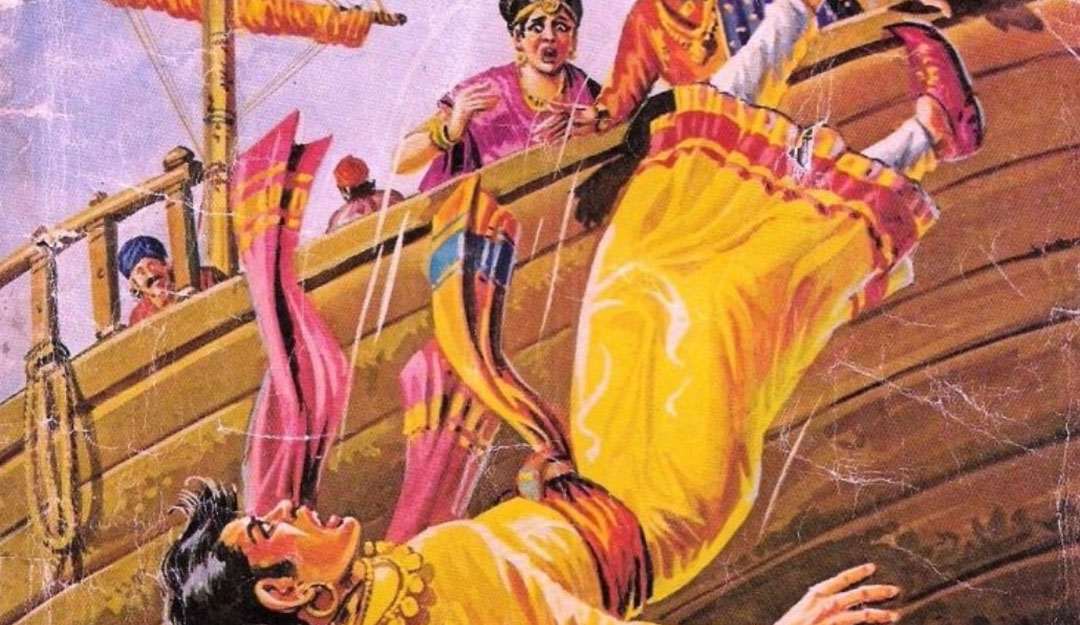
In the golden age of Indian comics, Manoj Comics was famous not only for its detective and superhero characters (like Ram-Rahim, Havildar Bahadur), but also for the social, mythological and folkloric stories covered under ‘Manoj Chitra Katha’. It was equally liked. “Roop-Basant” is a brilliant and memorable story of this series.
The story is based on the unwavering love of two brothers Roop and Basant, the oppression of the stepmother, the game of luck and finally the victory of goodness. In many states of India this story has been heard as a folktale, and Bimal Chatterjee has presented it in a very beautiful and easy-worded comic form.
The story of destiny and struggle
To understand the story better, we can see it in different parts:
Happy family and tragedy
The story begins with ‘Virat Dweep’, where King Ugrasen ruled. His life was spent in great happiness with his queen and two sons — Roop and Basant. But fate had decided something else. The queen suddenly falls ill and dies. The king and the two princes are deeply saddened by this incident. After the departure of his wife, King Ugrasen breaks down and also gives up the responsibility of governance. The king is ready to remarry at the constant insistence of the subjects and ministers. He marries a princess of a neighboring state ‘Padma’, but with a condition — that she will give their sons the love of a real mother.
Stepmother’s vicious cycle
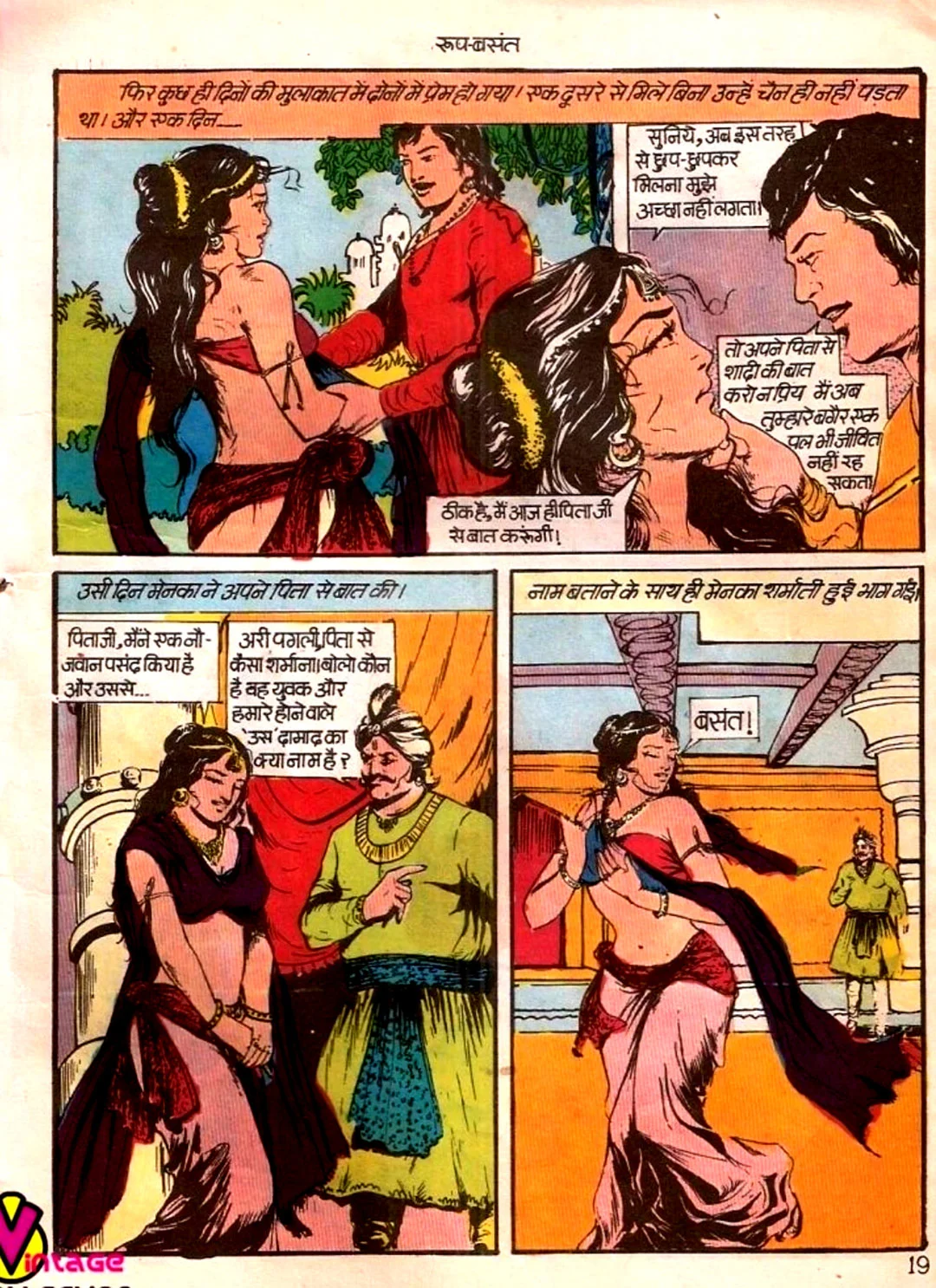
Everything goes well in the beginning, but as the years go by, Roop and Basant grow. Queen Padma, who seems considerably younger than the king in age, gradually begins to be captivated by the beauty and youthful charm of Roop. The story takes a very deep and shocking turn from here. Padma proposes love to Roop. But the sacramental Roop flatly refuses, calling it a sin, and addresses her as ‘mother’.
Due to this, Padma gets badly hurt and gets filled with anger in the fire of revenge. She lies to King Ugrasen that Roop treated her unfairly. The king, who was blinded by the love of his new wife, orders his own son Roop to be sentenced to death without any investigation.
Deportation and isolation
The executioners (soldiers) take Roop to the forest to kill him, but Basant also insists on going with his elder brother. The soldiers are heartbroken upon reaching the forest and instead of killing Roop, they give him a chance to escape, and return with the eyes and blood of an animal to deceive the king.
Both the brothers keep wandering in the forest for a long time. One night when both are sleeping under a tree, a poisonous snake bites Roop. When Basant wakes up, he thinks Roop is dead and starts crying bitterly. Meanwhile, people from the nearby state ‘Chakramgarh’ come there. Their king was dead and they were roaming around with a royal elephant in search of a new king. The elephant puts a garland around Basant’s neck — and while wandering in the forest with the game of luck, Basant becomes the king of ‘Chakramgarh’.
The struggle of Roop and new life
On the other hand, a snake charmer comes there and sees that Roop is not dead, but is in a state of unconsciousness due to the effects of poison. He treats him with herbs. Upon regaining consciousness, Roop is very sad not to find his younger brother.
From here Roop’s life takes a new and thrilling path:
Confronting the Lion: Roop reaches a city where a man-eating lion was terrorizing people. Roop shows courage and single-handedly kills the lion and saves the people.
Cheating: There is a potter watching all this. He knocks the injured Roop unconscious and takes full credit for killing the lion himself. The king rewards the potter and poor Roop is forced to wander from door to door again.
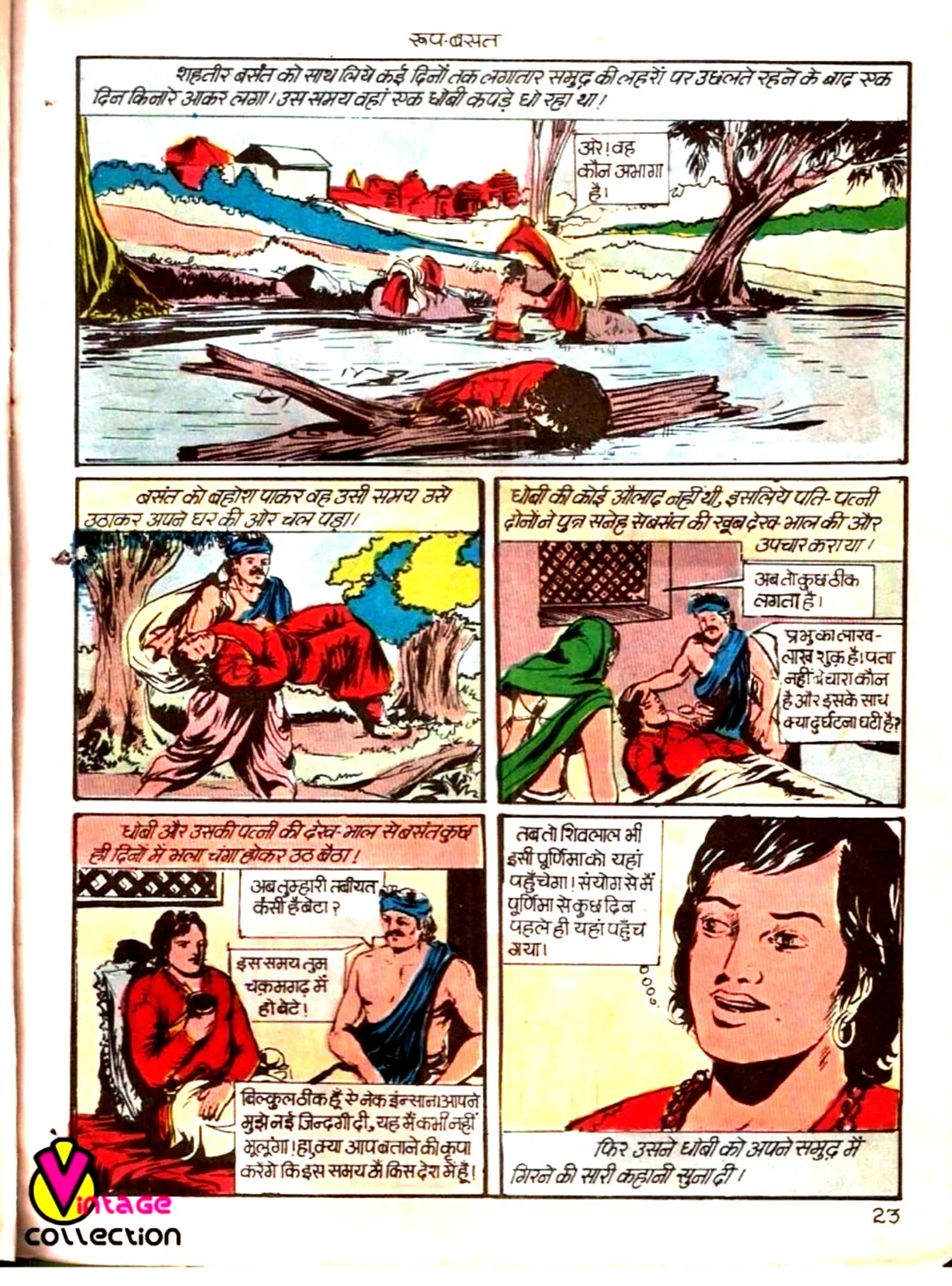
Merchant Shivlal: Roop is lying on the sea shore in an unconscious state, when he meets a merchant named Shivlal. Shivlal keeps him with him and takes Roop as his son.
Love, betrayal and reunion
Roop reaches ‘Lion Island’ while traveling with the merchant. While there he meets princess ‘Menka’. Both start liking each other and after some time they get married. But here too Roop’s luck does not leave him. At the time of return, the intentions of businessman Shivlal get spoiled regarding Menka. He takes advantage of the opportunity to fraudulently push Roop into the sea.
Menka cleverly keeps the businessman away from her to save her honour. Luckily, Roop does not drown, but survives and is rescued by a washerman on shore.
Eventually, the story takes a real emotional and explosive turn. Menka, Shivlal and Roop (who is now disguised as a washerman) arrive at King Basant’s court by chance. There a plea for justice is made in front of everyone. Basant recognizes his elder brother Roop. The two brothers embrace, the evil merchant is punished and both return to their father King Ugrasen. In the end the whole family reunites and the story ends with joy.
Character analysis
Roop: The main protagonist of the story. His character is very strong and has principles — just like Maryada Purushottam Ram. He followed his values and dignity by rejecting his stepmother’s wrong proposal. He is brave (killing the lion) and he never gives up even after suffering and deception. He symbolizes the ideal of Indian culture ‘obedient son’.
Basant: Younger brother, whose dedication and love for his brother is exactly like Lakshman. His becoming king shows that luck favors hardworking and noble people. He becomes an honest and just ruler.
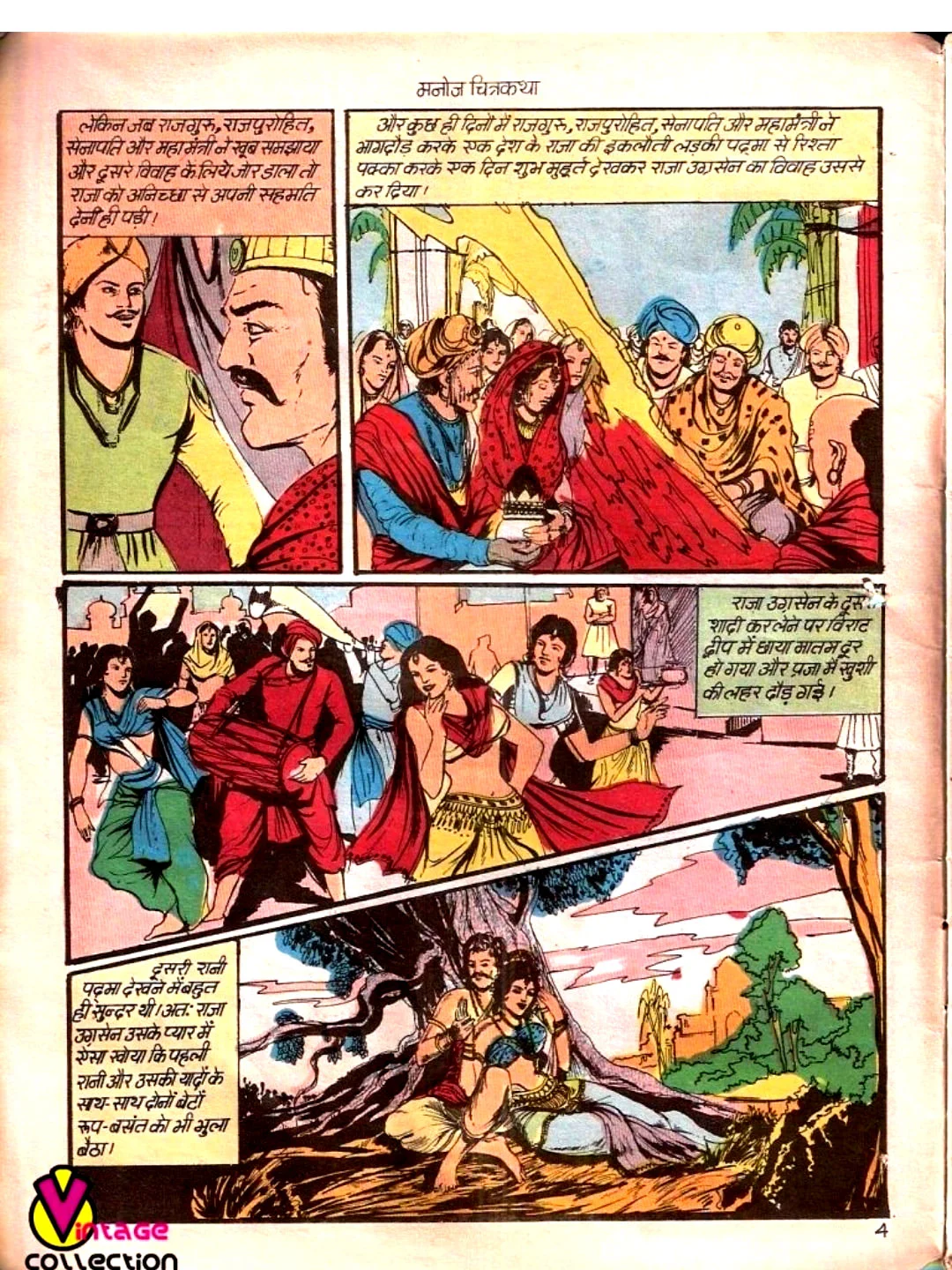
Rani Padma: The main villain of the story. She is like Kaikeyi and the mythical evil stepmother. Her character shows that a nature full of lust, jealousy and ego can destroy an entire family.
King Ugrasen: A weak father and ruler who loses his sanity blinded by his wife’s infatuation. He is a symbol of those people who get carried away by emotions and take wrong decisions.
Saudagar Shivlal and Kumhar: In the story, both of them represent those selfish people of society who do not hesitate at all in taking advantage of the hard work and troubles of others.
Illustration and art
‘Drawing by Vinod Art’ shows the special comic style of that period very well.
Cover Page: The cover page is extremely attractive and attention-grabbing, in which the scene of Roop falling from the ship and the scared Menka standing above looks spectacular and dramatic. The use of bright colors makes it even more effective.

The views of palaces, forests and sea are shown in a very detailed and beautiful manner. Especially clothing and ornaments — kings’ turbans, queens’ ornaments and soldiers’ uniforms — bring the mythological atmosphere of the story to life. The expressions on the faces of the characters are very clearly visible. Cleverness is easily felt on Queen Padma’s face, brilliance on Roop’s face and remorse on the king’s face. Yes, printing can look light or scattered in places like 80–90s comics, but that’s natural because of the technical limitations of that time.
Writing and Dialogue
Bimal Chatterjee’s writing style, despite being simple, is very effective.
Dialogue: The dialogues here have a very dramatic and filmy style, which were very much liked by the readers of that time. For example, when Rani Padma traps Roop or when Roop proves his innocence, the use of big and emotional Hindi words in dialogues deepens the impact of the entire story.
Narrative flow (Pacing): The story progresses at a very fast pace. You never feel bored while reading. One incident after another immediately unfolds—forest, snake bite, becoming king, lion fight, falling into the sea—it all shows how powerful and tightly written the story is.
